Background: We say that a metric space admit a bi-Lipschitz embedding (or just “embeds” for short) into metric space if there exist constants and a function such that . For , a -snowflake of metric space is the metric space on the same set X with distance . By space we mean, for concreteness, space of functions with norm .
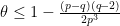
The Theorem: On 25th August 2014, Assaf Naor and Gideon Schechtman submitted to arxiv a paper in which they, among other results, proved that, for every , if is such that the -snowflake of admits a bi-Lipschitz embedding into , then necessarily .
Short context: It is known that, if , then does not embed into . Hence, if -snowflake of embeds into , then . Quantifying by “how much” is bounded away from 1 gives an important quantitative refinement of non-embeddability into . However, before 2014, no estimate in the form for any explicit function has been known. The Theorem provides the first such estimate. In fact, the authors conjectured that the inequality in the Theorem can be improved to , which would be the best possible. In a later work, Naor proved this conjecture.
Links: Free arxiv version of the original paper is here, journal version is here.


![\theta\in(0,1]](https://s0.wp.com/latex.php?latex=%5Ctheta%5Cin%280%2C1%5D&bg=ffffff&fg=000000&s=0&c=20201002)


![f:[0,1]\to{\mathbb R}](https://s0.wp.com/latex.php?latex=f%3A%5B0%2C1%5D%5Cto%7B%5Cmathbb+R%7D&bg=ffffff&fg=000000&s=0&c=20201002)




 Theorems of the 21st century
One thought on “If p>q>2, and the t-snowflake of L_q admits a bi-Lipschitz embedding into L_p, then t is bounded away from 1”