You need to know: Set  of integers,
  of positive integers.
Background: We say that integer n is non-zero perfect square if  for some integer
  . We say that equation
  is partition regular if for every partition of into finitely many classes, one of the classes contains distinct x, y that satisfy the equation for some
  . Note that
  is a special variable which is allowed to take any integer values.
The Theorem: On 4th March 2014, Nikos Frantzikinakis and Bernard Host submitted to arxiv a paper in which they proved, among other results, the following theorem. Let  , where
  are non-zero and
  are arbitrary integers. Suppose that the three integers
  ,
,  and
and  are all non-zero perfect squares. Then the equation
  is partition regular.
Short context: A classical theorem of Furstenberg and Sarközy from 1970-th states that if we partition into finitely many classes, we can always find  from the same class such that
  is a (non-zero) perfect square. In other words, equation
  is partition regular. In 2006, Khalfalah and Szemerédi proved the same for equation
  . The Theorem proves a similar result for a large family of quadratic equations. In particular, it implies that the equation
  is partition regular whenever integers , and
  are non-zero perfect squares. For example, this holds for the equation
  .
.
Links: Free arxiv version of the original paper is here, journal version is here.
Go to the list of all theorems


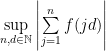


 for some integer k.
 that is not a perfect square, there are infinitely many prime numbers of the form
  with integer
  .
. . Friedlander and Iwaniec in 1998 resolves this question affirmatively for polynomial
  , Heath-Brown in 2001 – for
  , see
, see ![f:{\mathbb N} \to [-1,1]](https://s0.wp.com/latex.php?latex=f%3A%7B%5Cmathbb+N%7D+%5Cto+%5B-1%2C1%5D&bg=ffffff&fg=000000&s=0&c=20201002) is called multiplicative if
is called multiplicative if  and
and  holds for all coprime
  .
. (one can take
  ) such that for any multiplicative function
  , and any
  , inequality
  folds for all but at most
  integers
 ![x\in[X,2X]](https://s0.wp.com/latex.php?latex=x%5Cin%5BX%2C2X%5D&bg=ffffff&fg=000000&s=0&c=20201002) .
. of such function in short intervals of length h. The Theorem states that this is approximately equal to the average
  over “long” interval
 ![[X,2X]](https://s0.wp.com/latex.php?latex=%5BX%2C2X%5D&bg=ffffff&fg=000000&s=0&c=20201002) , which is much easier to estimate. This has a lot of applications, some of them are derived in the same paper.
, which is much easier to estimate. This has a lot of applications, some of them are derived in the same paper. denotes the n-th prime. For
  , let
, let  be the largest gap between consecutive primes below X. For
  , let
, let  . With notation
  for the r-th fold logarithm, this simplifies to
  .
. such that
  for all X.
 between consecutive primes below X grow with X? It is conjectured that
  , but this is wide open. See
  . For the lower bound, the authors
  , giving the first substantial improvement since 1938. The Theorem improves this bound by a
  factor. The authors argue that this bound in the limit of the current techniques, and a radically new approach will be needed to improve beyond this.
 . With notation
  .
. .
. for some constant
  by Erdős in 1935, and to
  by Rankin in 1938. This strange-looking bound, surprisingly, standed for almost 80 years, except of improvements by a constant factor. At last, the Theorem proves that
  . The same result was proved independently by Maynard. See
  such that
  .
. is the sum of three primes.
 . In 1956, Borozdkin proved that one can take
  . In 2002, Ming-Chit improved this to
  . The Theorem proves the conjecture for all odd integers. The case of even integers remains open.
 , such that
  for infinitely many values of n. In particular, one can take
  .
. case of the Theorem with constant
  . After this, a large group of mathematicians, working online, tried to prove Zhang’s theorem with as small
  as possible, and, by October 2013, achieved together
  . On 23rd October, Maynard announced that he, working alone, achieved
  . By the time he submitted the paper to arxiv in November, he improved this to
  . Even more importantly, Maynard’s Theorem works for all k.
 if
if  is a multiple of s.
 is called a distinct covering system (or just “covering system” for short) if there exist integers
  such that each integer n satisfies at least one of the congruences
  .
. .
. greater than N. Despite
  , but conjectured that this cannot be done for arbitrary large N, and the answer to the minimum modulus problem is negative. The Theorem confirms this conjecture.
 , such that
  for infinitely many values of n. The proof implies that one can take
  .
. for infinitely many n, and is wide open. Before 2013, it was not even known that
  infinitely often for any finite constant C. See
  . The Theorem proves that
  and then to
  .
. Theorems of the 21st century