You need to know: Prime numbers, arithmetic progression, logarithm, limit, infinite product.
Background: We denote by 


The Theorem: On 21st September 2010, Ben Green, Terence Tao, and Tamar Ziegler submitted to arxiv a paper which, among other results, finishes the proof of the following theorem. For any fixed integer 

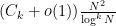


Short context: In a paper submitted in 2004, Green an Tao proved that, for any k, the set of primes contains infinitely many arithmetic progressions of length k. The Theorem counts how many such progressions exist. In a paper submitted in 2006, Green and Tao proved it for 
Links: Free arxiv version of the original paper is here, journal version is here. See also Section 10.8 of this book for an accessible description of the Theorem.
 let
let  denote the greatest prime factor of
  when
when  ,
,  , or
, or  .
. there is a constant
  , such that
  for all
  .
. for any integers
  and
and  . Can this lower bound be improved? In 1965, Erdős conjectured that
  as
as  . The Theorem (with
  ) proves Erdős conjecture (for any
  ) and gives the first improvement on Bang’s bound for 124 years. For general
  for
for  for large n. The Theorem provides a much better lower bound than
  . In fact, Stewart proved, much more generally, that the same lower bound holds for
  , where
  is the n-th term of Lehmer sequence. Previously, it was only known (as a corollary from
  for
for  .
. if b is divisible by a, and
  if not, notation
  for the set of rational numbers, elliptic curve over
  of elliptic curve E, limit superior
  , limit inferior
  , notation
  for the number of elements in any finite set S.
 , where
  are integers such that if
  for some prime p, then
  . The height of E is
  . For any h>0, let
  be the set of elliptic curves of height at most h. Also, let
  be the set of all elliptic curves having rank
  , and (ii)
  .
. is the average rank of elliptic curves of height at most h. In
  . Part (i) of the Theorem improves this to
  . Part (ii) of the Theorem states that a positive proportion of elliptic curves have rank
  for the greatest common divisor of integers x and y.
 be a binary cubic form with integer coefficients. F is called irreducible if it cannot be written as
  for some integers
  . Number
  is called the discriminant of F. Let
  be the set of primes dividing
  , and let
  be the set of nonzero integers u with the property that if u is divisible by some prime p then
  . Let
. Let  be the set of binary cubic forms F such that equation
  has no solutions in integers x and y.
 , equation
  has at most finitely many solutions in integers
  , such that
  and
and  .
. . The Theorem states that, for forms
  , this equation has at most finitely many solutions even if
  is also a variable. For example, the authors show that
  belong to
  .
. where r is the radius).
 be the curvature of the largest circle in
  depending on
  for all
  .
. for some constant
  and conjectured that this can be improved to
  for the set of positive integers,
  for the distance from real number x to the nearest integer. In addition, you need to know the concept of Hausdorff dimension of set
  to understand the context.
 such that
  and
and  . For
. For  , let
, let  denote the set of points
  for which there exists a positive constant
  such that
  for all
  .
. of pairs from S, the set
  is non-empty.
 such that
  for all
  of simultaneously badly approximable numbers. The Theorem confirms a 1983 conjecture of Schmidt. In fact, Schmidt conjectured it for specific values
  ,
,  , and
, and  , and even this remained open. Any counterexample to this conjecture would imply the famous Littlewood conjecture (see
  is not only non-empty, but has Hausdorff dimension 2 – the same as the whole plane. In a
  , big O notation.
![[k]=\{1,2,\dots,k\}](https://s0.wp.com/latex.php?latex=%5Bk%5D%3D%5C%7B1%2C2%2C%5Cdots%2Ck%5C%7D&bg=ffffff&fg=000000&s=0&c=20201002) and let
and let ![[k]^n](https://s0.wp.com/latex.php?latex=%5Bk%5D%5En&bg=ffffff&fg=000000&s=0&c=20201002) be the set of vectors
be the set of vectors  such that each
 ![x_i\in[k]](https://s0.wp.com/latex.php?latex=x_i%5Cin%5Bk%5D&bg=ffffff&fg=000000&s=0&c=20201002) . Let
. Let  be a vector such that each
  either belongs to
 ![[k]](https://s0.wp.com/latex.php?latex=%5Bk%5D&bg=ffffff&fg=000000&s=0&c=20201002) or equal to the wildcard value *. Assume that at least one coordinate of y takes the wildcard value *. For
or equal to the wildcard value *. Assume that at least one coordinate of y takes the wildcard value *. For  , let
, let ![y^j \in [k]^n](https://s0.wp.com/latex.php?latex=y%5Ej+%5Cin+%5Bk%5D%5En&bg=ffffff&fg=000000&s=0&c=20201002) be a vector obtained from y by setting all the wildcards * equal to j. The set
be a vector obtained from y by setting all the wildcards * equal to j. The set  is called a combinatorial line. Let
  be a function such that
  for all k,
  for all n, and
  for all
  .
. , there exists a positive integer
  such that if
  elements, then A contains a combinatorial line. Moreover, one may take
  and
and  for
for  .
. and any
  , there exists a positive integer
  such that every subset of the set
  of size at least
  contains an arithmetic progression of length k. In 1991, Furstenberg and Katznelson proved the statement of the Theorem without “moreover” part, and called it “the density Hales-Jewett theorem”. This theorem greatly generalises (and easily implies) the Szemerédi theorem. However, the proof of Furstenberg and Katznelson does not imply any explicit algorithm how to actually compute
  and
and  . The Theorem provides such an algorithm. It also has much simpler proof. It is proved by a large group of mathematicians in an online discussion, which is called a Polymath project.
 for positive real numbers, Euclidean space
  of vectors
  , norm
  , set
, set  of vectors with integer coordinates, affine subspace of
  , the notion of (Lebesgue) almost all.
 , let
, let  . For a decreasing function
  , let
, let  be the set of points
  holds for infinitely many positive integers m. Let
  , where U is an open subset of
  and
and  is an analytic map. We will call M analytic submanifold of
  such that
  , almost all points on M belong to
  , then all coordinates of x can be simultanuously approximated by rational numbers with the same denominator, where function
  .
. and
and  , notion of “almost all”, sum of infinite series, standard notations
  for integers,
  for derivative,
  for the second derivative.
 is called simultaneously
  such that
  , where
  denotes the distance from x to the nearest integer.
 . Let f be a twice continuously differentiable function on some interval
  , such that
  for almost all
  . Then for almost all
  is not simultaneously
  be the set of all pairs
  . It is called of Khintchine type for convergence if almost all points on it does not belong to
  Theorems of the 21st century