You need to know: Prime numbers, relatively prime integers.
Background: Let  be an integer. Any integer
  can be uniquely represented as
  , where
  is an integer and
  are integers between
  and
and  , which are called digits of n in the q-ary number system (if
  , these are the digits in the usual decimal system). Let
  be the sum of digits of n. Let
  be the number of primes less than n, and let
  be the number of primes p less than n such that
  is a multiple of m.
The Theorem: On 10th November 2005, Christian Mauduit and Joël Rivat submitted to the Annals of Mathematics a paper in which they proved that for all integers  and
and  such that and
  are relatively prime, there exist constants
  and
and  , such that the inequality
  holds for all integers and all integers
  .
.
Short context: Because  is known to be negligible comparing to for large n, the theorem states that
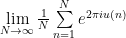
  , that is, the primes whose sum of digits gives any fixed reminder after division by m occupies about
  of all primes, as intuitively expected. This answers the 1968 question of Gelfond. In the special case and
  , it states that asymptotically half of all primes have the even sum of digits, and half of primes have the odd sum of digits.
Links: The original paper is available here. See also Section 10.7 of this book for an accessible description of the Theorem.
Go to the list of all theorems


 for the set of vectors
  with integer
  .
. is a polynomial family with k parameters if there are exist n polynomials
  in k variables with integer coefficients such that
  such that
  .
. is a polynomial family with 46 parameters.
 exists for any bounded generalized polynomial
  .
. if
if  is a multiple of q.
 of an integer
  is a sequence
  of integers such that
  . The difference
  is called the rank (or Dyson’s rank) of
  denote the number of partitions
  .
. be a prime such that
  is not divisible by
  such that for every
  we have
  .
. is the number of partitions of integer
  always divisible by 5,
  – by 7,
  – by 11. In 2000, Ono proved that for any prime
  there exist positive integers A and B such that
  for all
  (however, there are no prime
  for which we can take
  , see
, see  .
. denotes the n-th prime number.
 .
. for infinitely many n, and is wide open. The 1896 prime number theorem implies that the average size of
  is about
  , hence
  is at most 1. In 1940, Erdős proved that
  for some small
  . This bound was then improved by many authors. In 1988, Maier proved that
  , and this remained the best bound until 2005. The Theorem proves that
  . See
. See  if
if  is a multiple of s.
 is called a covering system if there exist integers
  such that each integer n satisfies at least one of the congruences
  .
. , such that inequality
  holds for any covering system S with
  .
. greater than N. In 1973, Erdős and Selfridge conjectured that this is not true if we also require that sum of reciprocals
  of elements of S is bounded by some constant B. The Theorem confirms this conjecture. In particular, this implies that for any number
  and N sufficiently large, depending on K, there is no covering system S with all
 ![(N,KN]](https://s0.wp.com/latex.php?latex=%28N%2CKN%5D&bg=ffffff&fg=000000&s=0&c=20201002) . In a
. In a  , thus solving the original Erdős problem.
 .
. , and any integer coefficients
  , the system of equations
  has a non-trivial solution in integers if and only if it has a non-trivial solution in the 7-adic field.
 with integer coefficients
  . For cubic equations, the Hasse principle fails in general, but The Theorem implies that it holds for the system
  , and fails for
  , hence the condition
  of integers, greatest common divisor (gcd) of 2 integers, set
  of complex numbers,
  is called a Dirichlet character modulo integer
  if (i)
  for all n, (ii) if
  then
then  ; if
; if  then
then  , and (iii)
  for all integers m and n. An example is character
  such that
  whenever
  otherwise. This character is called principal and all other characters – nonprincipal. The order of a Dirichlet character
  is the least positive integer m such that
  for all n.
  such that
  whenever
  and
and  .
. where
where  , and
, and  is a constant depending only on g.
 for any nonprincipal Dirichlet character
  in terms of q is possible. The Theorem provides an improved bound for characters of odd, bounded order.
 are called quintic. For
  , let
, let  denotes the number of non-isomorphic number fields of degree n with absolute value of the discriminant at most X. Also, let
  be the set of prime numbers.
 exists and is equal to
  .
. for every fixed n, but, before 2004, this was known only for
  (see
(see 
 Theorems of the 21st century