You need to know: Graph, clique, independent set, small o notation, polynomial time algorithm.
Background: A graph on n vertices is called a k-Ramsey graph if it contains no clique or independent set of size k. By an explicit construction of a k-Ramsey graph we mean a polynomial time algorithm that, given the labels of two vertices in the graph, determines whether there is an edge between them. For n-vertex graph, the input of such algorithm has  bits, hence the running time should be polynomial in
  .
.
The Theorem: On 14th June 2015, Gil Cohen submitted to arxiv a paper in which he proved the existence of an absolute constant  such that there is an explicit construction of a
  -Ramsey graph over
  vertices.
Short context: In 1947 Erdős used the probabilistic method to show that most graphs on vertices are  -Ramsey. Interestingly, there is no known explicit example of such a graph for large n. Before 2015, the best explicit construction was achieved by Barak, Rao, Shaltiel, and Wigderson, who constructed k-Ramsey -vertex graphs for
  , see here. The Theorem provides a significantly better construction. The same result was achieved independently by Chattopadhyay and Zuckerman, who posted their paper online on 23rd July 2015. In a later work (submitted in 2018), Li gave an even better explicit construction achieving
  .
.
Links: Free arxiv version of the original paper is here, journal version is here.
Go to the list of all theorems


 , product notation
  , matrices.
 matrix with elements
  is called an alternating-sign matrix (ASM) if (i) all
  for all
  .
. DASASMs is given by
  .
. for some fixed
  .
. time algorithm discovered by Babai and Luks in 1983 remained the fastest one working for all n-vertex graphs. The Theorem provides a much faster algorithm. Algorithms with running time
  be the number of integral solutions of the system of equations
  ,
,  , such that
  for
for  .
. and
and  , and any real
  , there exist a constant
  such that
  for all
  .
. factors. Before 2015, the conjecture
  , and, more recently, for
  . The Theorem confirms the conjecture in general.
 for the emply set,
  for the number of elements in finite set X (also called the cardinality of X),
  for the set of all subsets of X,
  for the set
  .
. , where X is a finite set and
  is a family of its subsets, such that (i)
  ; (ii) if
  and
and  then
then  ; and (iii) if
  , and
, and  , then there exists
  such that
  . The rank of M is
  . Similarly, the rank of any subset
  is
is  . Polynomial
  is called the characteristic polynomial of matroid M. For
  , let
, let  be the absolute value of the coefficient of
  in
in  . Also, let
  be the number of sets
  . A sequence
  of non-negative real numbers in called log-concave if
  for
for  .
. is log-concave, and (ii) the sequence
  is log-concave.
 for the set of natural numbers, notation
  for the supremum.
 be an infinite sequence such that each
  is either
  or
or  . The discrepancy of f is
 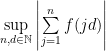 .
. . The problem asking to prove or disprove this conjecture became known as the Erdős discrepancy problem. It is one of Erdős’s most famous problems, attracted a lot of attention, but, before 2014, was open even for
  . In 2014, Konev and Lisitsa solved the
  for some integer k.
 that is not a perfect square, there are infinitely many prime numbers of the form
  with integer
  .
. . Friedlander and Iwaniec in 1998 resolves this question affirmatively for polynomial
  , Heath-Brown in 2001 – for
  , see
, see  for the number of elements in finite set S, Euclidean space
  , polytope, convex hull.
 be a graph with vertex set V and edge set E. A set
  of edges of G is called matching if no two edges in M share a common vertex. A matching is called perfect if
  . Let us enumerate the edges of G from
  to
to  . For any subset
  , let
, let  be the characteristic vector of S, that is, i-th coordinate of
  is
is  otherwise. The
  in graph G is the convex hull of all characteristic vectors of perfect matchings in G. An e
 for some constant c.
 for the complete graph on n vertices.
 , is the minimum integer m such that in every edge two-colouring of
  there exists a monochromatic copy of H. A graph H is called d-degenerate if all its subgraphs contain a vertex of degree at most d.
 such that every d-degenerate graph H on n vertices satisfies
  .
. are finite for all positive integers n. This result originated a large body of research, which is now considered as one of the most important research directions in combinatorics, see
  Theorems of the 21st century