You need to know: Hilbert space  , Banach space B, notation
  for norm in B, convergence in this norm, isomorphic Banach spaces, dimension of a Banach space, finite and infinite dimensional Banach spaces, subspace of a Banach space, bounded linear operator K between Banach spaces, range of K, compact set in a Banach space.
Background: A sequence  of a Banach space B is called basis of B if every
  has a unique representation of the form
  for some real numbers
  . Two bases and
  of B are called equivalent if series converges in B if and only if
  converges. A basis of B is called symmetric if every permutation of is a basis of B equivalent to .
A Banach space B is said to have the approximation property (AP) if for every compact set K in B and for every  , there is a bounded linear operator
  , whose range is finite-dimensional, and such that
  for all
  . We say that Banach space B has the hereditary AP (or is a HAPpy space) if all of its subspaces have the AP.
The Theorem: On 7th November 2010, William Johnson and Andrzej Szankowski submitted to the Annals of Mathematics a paper in which they proved the existence of a HAPpy Banach space, not isomorphic to the Hilbert space , which has a symmetric basis.
Short context: The first examples of HAPpy Banach spaces not isomorphic to a Hilbert space was constructed by Johnson in 1980. Later, Pisier constructed more such examples, but none of them have a symmetric basis. In fact, Johnson asked in 1980 whether there exists any HAPpy space, other than , that has a symmetric basis. The Theorem answers this question affirmatively.
Links: The original paper is available here.
Go to the list of all theorems
 , let
, let  be the cardinality of the largest subset of
  which contains no nontrivial 3-term arithmetic progressions.
 .
. . In 1953, Roth confirmed this conjecture by proving that
  . In 1999, Bourgain improved this to
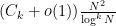
  . The Theorem proves a much stronger upper bound, the first one in the form
  . In a later work, Bloom improved the bound slightly to
  .
. , origin
  , basic probability theory, simple random walk on
  be the largest integer not exceeding t.
 , construct a random set
  such that (i)
  , and (ii) for each
  be
be  plus the first point at which a simple random walk from the origin hits
  . For any real
  , let
, let  . For
. For  , let
, let  .
. for all sufficiently large r.
 , Euclidean distance in
  in
in  and
and  are equivalent if
  . The distortion of knot representative
  , where
  denotes the arclength along
  denotes the Euclidean distance in
  .
. there exists a knot K in
  .
. . The Theorem shows that this is not the case, with any constant in place of
  . In fact, Pardon presented explicit examples of families of knots with distortion going to infinity. For example, let
  be the curve in
  ,
,  ,
,  , where
  and
and  . Set
. Set  of curves equivalent to
  -torus knot. Pardon proved that
  . The Theorem follows.
 for the set of positive integers, Euclidean space
  , sphere in
  , integration over
  be a sphere in
  normalised such that
  . A set of points
  is called a spherical t-design if equality
  holds for all polynomials P in
  variables, of total degree at most t.
 there exist a constant
  such that for each
  and each
  , there exists a spherical t-design in
  . In 1993, Korevaar and Meyers conjectured the existence of spherical t-designs in
  points, which is optimal up to the constant factor. The Theorem confirms this conjecture.
 any function
  such that
  . Let
. Let  denote the set of all prime numbers.
 , the number of k-tuples of primes
  which lie in arithmetic progression is
  , with
  , where
  if
if  and
and  if
if  .
. and also proved that the general case (and in fact much more general theorem called “The generalised Hardy-Littlewood conjecture in finite complexity case”) would follow from two new conjectures they formulated. They then, together with Ziegler, proved these conjectures, which finishes the proof of the Theorem.
 of real numbers is called log-concave if
  for all
  . For a finite graph G and integer
  , let
, let  be the number of proper colouring of vertices of G with q colours. It is known that
  , where
  are non-negative integers.
 for some
  ). In 1971, Rota conjectured that this sequence is in fact log-concave and observed that this would imply the Read’s conjecture. The Theorem confirms this prediction. In fact, Rota conjectured an even more general statement, which was also
  let
let  denote the greatest prime factor of
  when
when  ,
,  .
. there is a constant
  , such that
  for all
  .
. for any integers
  and
and  . Can this lower bound be improved? In 1965, Erdős conjectured that
  as
as  . The Theorem (with
  ) proves Erdős conjecture (for any
  ) and gives the first improvement on Bang’s bound for 124 years. For general
  for
for  for large n. The Theorem provides a much better lower bound than
  . In fact, Stewart proved, much more generally, that the same lower bound holds for
  , where
  is the n-th term of Lehmer sequence. Previously, it was only known (as a corollary from
  for
for  .
. . Let
. Let  be a finite family of events in
  , let
, let  be the (unique) minimal subset of
  . For
. For  be the set of
  such that
  but
but  . We say that an evaluation of the variables in
  such that
 ![\forall A\in S: \text{Prob}[A]\leq x(A) \prod\limits_{B\in \Gamma_S(A)} (1-x(B))](https://s0.wp.com/latex.php?latex=%5Cforall+A%5Cin+S%3A+%5Ctext%7BProb%7D%5BA%5D%5Cleq+x%28A%29+%5Cprod%5Climits_%7BB%5Cin+%5CGamma_S%28A%29%7D+%281-x%28B%29%29&bg=ffffff&fg=000000&s=0&c=20201002) , then there exists an assignment of values to the variables in
, then there exists an assignment of values to the variables in  .
. of matrix A.
 denote the eigenvalues of
  symmetric matrix A. If all
  are non-negative, A is called positive semidefinite, while if all
  be the set of all positive definite
  , we write
  if
if  is positive semidefinite. The trace metric distance between
  . The least squares mean (also known as Karcher mean) of k matrices
  is
is  .
. ,
,  , then
  .
. Theorems of the 21st century