You need to know: Polynomial, operation of taking the integer part, limit, complex numbers, complex exponent.
Background: A generalized polynomial is a real-valued function which is obtained from conventional polynomials in one or several variables and applying in arbitrary order the operations of taking the integer part, addition, and multiplication.
The Theorem: On 17th October 2005, Vitaly Bergelson and Alexander Leibman submitted to the Acta Mathematica a paper in which they proved, among other results, that the limit 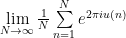

Short context: The Theorem gives a positive answer to a 1996 question of Bergelson and Håland. It is just one of the many corollaries of deep theory on the distribution of values of bounded generalized polynomials developed by authors.
Links: The original paper is available here.
Go to the list of all theorems
 if
if  is a multiple of q.
 of an integer
  is a sequence
  of integers such that
  . The difference
  is called the rank (or Dyson’s rank) of
  denote the number of partitions
  .
. be a prime such that
  is not divisible by
  such that for every
  we have
  .
. is the number of partitions of integer
  always divisible by 5,
  – by 7,
  – by 11. In 2000, Ono proved that for any prime
  there exist positive integers A and B such that
  for all
  (however, there are no prime
  for which we can take
  , see
, see  to some
  will be called A–B-path. We say that set S of vertices of G separates A from B if every A–B-path contains at least one vertex
  .
. be the minimal size of set S which separates A from B, and let
  be the maximal size of a family of vertex-disjoint paths from A to B. Obviously,
  . In 1931, König proved that equality
  holds for every finite bipartite graph G. By an earlier 1927 theorem of Menger, this implies that
  (field with elements
  and operations modulo p, p prime), matrices, matrix multiplication, determinant of a
  matrix, group, finite group, group
  (group of
  be the minimal integer m such that every
  can be expressed as a product of at most
  for every prime p and every set A of generators of
  for every set A of generators of a non-abelian finite simple group G with
  elements. The conjecture is open. See
  . The crucial contribution is that constants M and c in the Theorem does not depend neither on A nor on p.
 .
. denotes the n-th prime number.
 .
. for infinitely many n, and is wide open. The 1896 prime number theorem implies that the average size of
  is about
  , hence
  is at most 1. In 1940, Erdős proved that
  for some small
  . This bound was then improved by many authors. In 1988, Maier proved that
  , and this remained the best bound until 2005. The Theorem proves that
  . See
. See  , metric space
  with metric
  , big O notation.
 can be embedded into metric space
  with distortion at most
  if there exists a function
  such that
  , where
  are constants such that
  . We say that a finite metric space
  is of negative type if for any real numbers
  with
with  we have
  .
. .
. . The Theorem improves this to
  , established by Enflo in 1969, up to insignificant
  factor. The Theorem implies the existence of efficient approximation algorithm for the famous Sparsest Cut problem, which is more accurate than any previous one.
 of edge deletions that are needed in order to turn G into a graph satisfying P.
 to within an additive error of
  . On the other hand, if all bipartite graphs satisfy P, then for any fixed
  it is NP-hard to approximate
  .
. , notation
  for length of
  , matrix, matrix multiplication, inverse matrix, norm
  of
of  matrix A.
 for all
  . For integer
  , let
, let  be an
be an  are i.i.d. with the same distribution as X.
 and variance
  . Then there are positive constants
  ,
,  , and
, and  such that for any integer
  , the inequality
  holds with probability greater than
  .
. with equal chances (Bernoulli matrices). It is
  of the inverse matrix. The bound is polynomial in n and holds with probability greater than
  if n is large enough. Previously, similar bound was known only if i.i.d. entries
  with distance
  , integration,
  space for
  (space of measurable functions such that
  ), injective function, inverse
  of function
  .
. be metric spaces. A function
  is called uniformly continuous if for every
  for every
  with
with  . We say that M embeds uniformly into N if there is an injective function
  ,
,  if and only if
  or
or  .
. , limit superior
  , ball
  with centre x and radius
  , integration in
  .
. (which we call a weight function) denote
  the “weighted volume” of set
  . For a function
  its weighed average on S, and
  its weighted deviation from the average. We say that weight function
  , if (i) there is a constant
  such that
  holds for all
  for every ball B, and (iii) there are constants
  and
and  such that the inequality
  holds for all balls
  , and for every Lipschitz continuous function
  (this is called the
  -Poincaré inequality).
 -admissible weight for some
  , then there exists an
  such that
  is
is  .
. , and the smaller p the better control. The Theorem, however, implies that we cannot have the smallest
  such that it holds: the inequality either holds for all
  , or for values of p from some open interval.
 Theorems of the 21st century